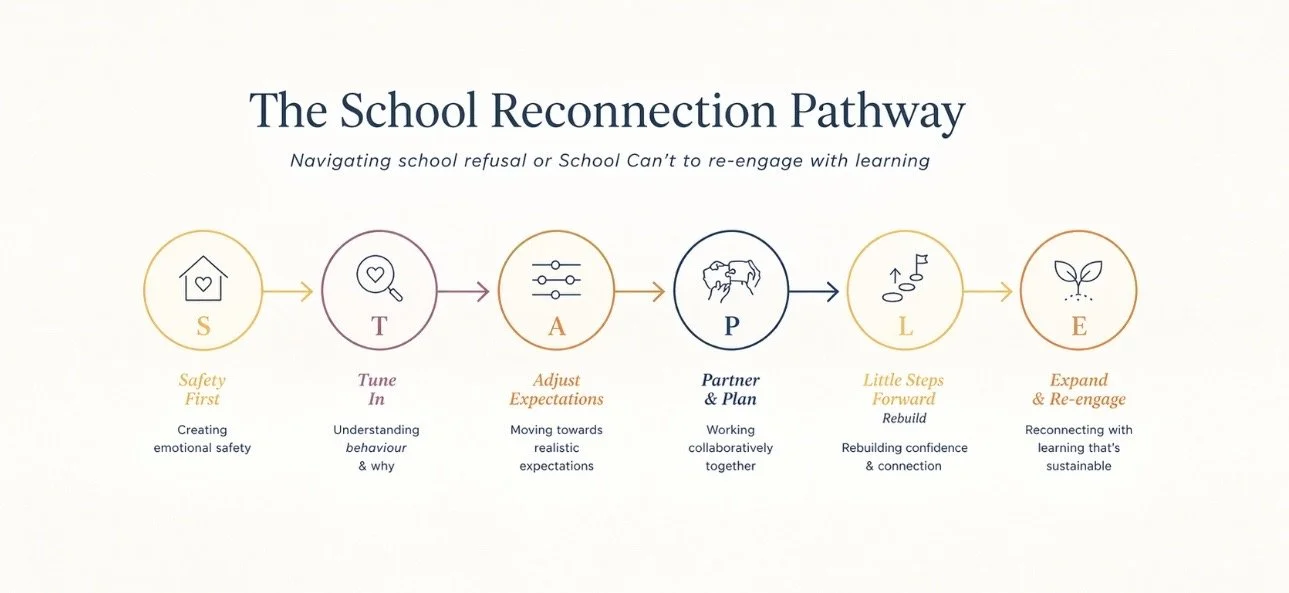
What is School Refusal or School Can’t?

What does School Refusal/Can’t look like?

For a CHILD

School Refusal/Can’t can look like:

  • Showing signs of distress, anxiety or depression about going to school.

  • Teariness the night before school or complaining about illness.

  • Having meltdowns or displaying aggressive behaviour.

  • Shutdown - no capacity for anything.

  • Refusing to get out of bed or to leave the house.

  • Significant increase in the use of screens.

  • Avoiding challenging days at school, such as tests, exams, camps or sport events.

  • Having trouble returning to school after significant breaks.

  • Being suspended from school.

For PARENTS

School Refusal/Can’t can look like:

  • Frustration, distress & being overwhelmed.

  • Emotional and physical exhaustion.

  • Impacting ability to attend workplace, creating financial stress.

  • Disagreements between parents about how to deal with the situation.

  • Breakdown in relationships; with child, partner, school, extended family or friends.

  • Concern for your child or young person’s education & future.

  • Not knowing what to do next for their child.

  • Feeling totally alone on this journey.

  • Difficulty often finding supports or people who understand.

School refusal or school can’t - what’s the right terminology?

Traditionally, school refusal has been used to describe a child who appears to be refusing to attend school, often framed as a behaviour choice.

But many families and professionals now use school can’t - shifting the lens from won’t to can’t.

This perspective recognises that a child isn’t being defiant; they’re overwhelmed, distressed, or unable to cope with the environment.

Support for families experiencing School Refusal or School Can’t?

School Refusal / Can’t impacts the whole family’s well-being, your relationships and the ability to see a positive future. Experiencing school refusal/can’t can feel overwheming, isolating and emotionally exhausting.

MODULE 1 - Understanding School Refusal or School Can’t & shifting perspectives.

  • What is School Refusal or School Can’t

  • Impact on Relationships

  • What works & what doesn’t.

MODULE 2 - Applying this knowledge to your own family’s experience of School Refusal/Can’t.

  • School expectations & your child’s responses.

  • What parents can control on the School Refusal/Can’t journey.

  • Interview with a 21 year old young person who experienced school can’t and what helped them.

MODULE 3 - Parents’ Differing Perspectives - Part 1 & 2

  • Parent’s Intentions & the different strategies they use.

  • The Protective Patterns your child displays that can hold you back.

  • What can we do as parents?

  • A Trust Measuring Exercise - what to do and say to build trust with your child & your child’s other parent.

  • How we come together to a shared understanding with a shared plan.

MODULE 4 - Working with Schools

  • Key ingredients to working with school.

  • A strategy to understand your child’s enjoyment & feelings of success about school.

  • Reasonable Adjustments & your child’s rights.

  • How to show up as a Professional Parent.

  • A 12 Page Document of Reasonable Adjustments to suggest to school.

MODULE 5 - The Power of Parents Mindset

  • Reframing progress on the School Can’t journey.

  • Using the Well-Being Wheel to identify the reasons why it is hard to attend school.

  • Stories from parents who have found the way through education toward a compelling future for their child and family.

Working with family’s, I have seen that every journey is different relating to School Refusal or School Can’t. There are however, similar themes that arise - what about my child’s future, how ask for adjustments at school, building networks who understand. working together to parent & self care.

‘Evidence-based. Lived experience. Real support‘.

What if you could:

  • Ask for school adjustments with clarity and confidence.

  • Feel steady and sure in your parenting approach.

  • Stop second-guessing yourself or being swayed by others’ opinions.

  • Set realistic goals with your child & their school.